Evening Rush on Westshore Boulevard: A Scene Set for Disruption
It’s 5:30 p.m. on Westshore Boulevard, and the steady stream of cars crawling toward the Interstate 275 interchange is already testing the patience of drivers leaving Tampa’s Westshore District. The familiar congestion near the intersection of Westshore Boulevard and Cypress Street feels relentless, especially as commuters from Hyde Park and Palma Ceia neighborhoods try to navigate around the snarled traffic heading to Tampa International Airport or downtown. For residents and workers in this 10-square-mile business hub, the bottleneck is more than an annoyance—it’s a daily obstacle that disrupts schedules and frays nerves.
What’s Happening: The Westshore Interchange Reconstruction Begins
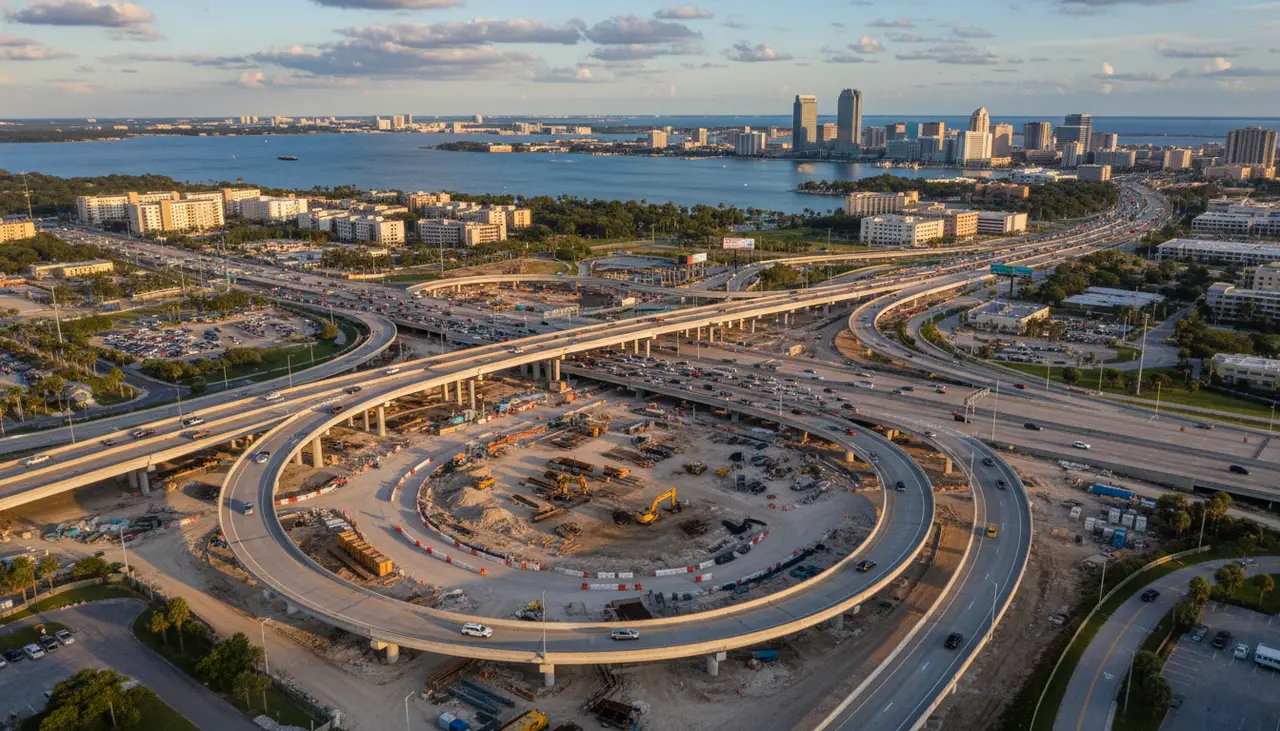
Florida Department of Transportation (FDOT) has officially awarded the $643 million contract to reconstruct the Westshore Interchange to a joint venture between Lane Construction Corporation and Superior Construction. This marks the largest FDOT project in the Tampa Bay region, focusing on the full overhaul of one of the area’s most congested highway nodes.
The project covers the interchange at Interstate 275 near Westshore Boulevard and includes upgrades stretching east along the Howard Frankland Bridge toward downtown Tampa, as well as improvements north on State Road 60 extending to State Road 589. Key features include new elevated ramps to enhance access to Tampa International Airport, widened lanes on State Road 60, and a network of new flyover and tolled direct-connect ramps to smooth traffic flow between I-275, the Veterans Expressway, and SR 60.
Construction began in 2023 following an initial $10 million design contract, and the phased design-build approach means engineering and construction are proceeding simultaneously. The project is scheduled for completion in December 2029.
Why This Matters to Tampa Residents
For the roughly 180,000 commuters who pass through this interchange daily—and the estimated 400,000 motorists expected to benefit once the project is complete—the stakes are high. Congestion here has long been a choke point, causing delays that ripple through Tampa’s Westshore District, Hyde Park, Palma Ceia, and beyond.
Traffic backups don’t just waste time; they increase the risk of accidents, elevate stress levels, and contribute to wear and tear on vehicles. For local businesses—numbering around 4,000 in Westshore—the current traffic snarls can mean lost productivity and frustrated customers. The lack of reliable airport access ramps also impacts tourism and freight movement, critical to Tampa’s economy.
The addition of express lanes, pedestrian and cycling infrastructure, and a redesign that separates local from through traffic aims to reduce these risks. But until the project is finished, residents and commuters must brace for disruptions that could affect daily life and safety.
If This Affects You: What to Do Now
- Plan extra travel time: Expect delays near Westshore Boulevard, Cypress Street, and the Howard Frankland Bridge, especially during peak hours.
- Stay updated: Follow FDOT announcements for detours and lane closures affecting I-275, State Road 60, and nearby streets.
- Use alternate routes cautiously: Side streets in Hyde Park and Palma Ceia may see increased traffic—drive defensively and watch for pedestrians and cyclists.
- Secure your home and property: Construction vibrations and heavy equipment movement can cause damage; inspect your property regularly.
- Communicate with your employer: If you work in Westshore or downtown Tampa, discuss flexible hours or remote options to avoid peak congestion.
- Report hazards promptly: If you notice unsafe road conditions or construction-related damage, contact local authorities immediately.
- Prepare for noise and dust: Residents near the interchange and along State Road 60 should take precautions to minimize exposure.
When Professional Help Becomes Necessary
Construction of this magnitude inevitably leads to situations where professional assistance is critical. If you experience damage to your home or vehicle from construction activity, you need to contact a qualified contractor and possibly a legal professional to assess and pursue claims.
Residents and businesses facing significant property disruptions or disputes over access should consult planners or legal experts familiar with transportation projects and eminent domain issues. Likewise, if construction delays cause accidents or injuries, you must seek legal counsel promptly to protect your rights.
For those managing traffic flow or property near the project, professional traffic planners and civil engineers can provide guidance on mitigation strategies and compliance with new infrastructure changes.
Local Context: What Tampa Residents Should Know
The Westshore Interchange is more than just a highway junction—it’s the gateway to Tampa’s busiest business district, a crucial link for neighborhoods like Hyde Park and Palma Ceia, and the main route to Tampa International Airport. Many residents pass through this area daily, whether commuting to work, running errands, or traveling to the airport.
As construction progresses, expect ongoing disruptions that will affect your daily routines and safety. Ignoring detours or failing to plan for delays could cost you time, money, and peace of mind. This project will reshape traffic patterns in Tampa for decades, but the next several years require vigilance and proactive steps from every driver, resident, and business owner in the area.
Where This Is Happening in Tampa
The Westshore Interchange reconstruction centers around the intersection of Interstate 275 and Westshore Boulevard, touching key local streets such as Cypress Street and Westshore Plaza Drive. The project stretches east toward the Howard Frankland Bridge, connecting to downtown Tampa, and extends north along State Road 60 to State Road 589.
Nearby neighborhoods include the commercial-heavy Westshore District, the historic residential areas of Hyde Park, and the well-established Palma Ceia. Tampa International Airport, a major regional landmark, lies just west of the interchange, making this corridor vital for travelers and freight alike.
Locals frequently use Westshore Boulevard and the Veterans Expressway to commute, and many depend on the Howard Frankland Bridge for daily travel between Tampa and St. Petersburg. This project will directly impact those routes, requiring residents to adapt to changing traffic patterns and ongoing construction for years to come.